A Dutch citizen can buy a house in Jávea in their own name. The passport is not the hurdle. The work is the NIE, a lawyer who is yours, and the taxes due when the deed is signed.
Buying a house in Jávea as a Dutch citizen in 2026
A Dutch citizen can buy a house in Jávea in their own name. The passport is not the hurdle. The work is the NIE, a lawyer who is yours, and the taxes due when the deed is signed.
Moments Estates is a Dutch-owned agency in Jávea. The team works in Dutch, English and Spanish, from the office at Avenida Lepanto 8. This is the practical path for someone who still lives in the Netherlands and wants a home in Jávea, also written Xàbia, in 2026.
What your nationality does not change
The Valencian purchase taxes do not rise because you are Dutch, and they do not fall either. A buyer who lives in the Netherlands pays the same transfer tax as a buyer who already lives in Spain. The current rules have no extra rate for nationality.
Reduced rates do exist. They cover a first habitual home, and in some cases buyers under 35, large families and other situations tied to living in the home and to income limits. If you remain tax-resident in the Netherlands, do not assume those rates apply to you. Your lawyer checks that before you rely on a lower figure.
You can buy in one name or in joint names. A Spanish company is a separate choice, with its own tax life. Most private buyers from the Netherlands do not need one for a house they will use themselves.
The order that keeps the purchase clean
- Get a NIE, the foreigner identity number. You need it for the deed, the tax payment and, in practice, a Spanish bank account. You can apply in Spain, or through the Spanish consulate in Amsterdam. A lawyer can apply with a power of attorney if you are not in the country. The official form fee is small. The appointment is what takes time.
- Instruct your own Spanish lawyer before any deposit you cannot afford to lose. That lawyer is not the seller’s lawyer, and not a substitute for the agent.
- Open a Spanish bank account. Purchase tax, council tax and utilities are simpler from a local account.
- Judge the house against recent sales in that part of Jávea, not against a national average.
- Have the lawyer read the title, debts, community fees, the pool licence, and any extension that is not on the title, before the deposit contract.
- The reservation and the deposit are negotiated. Spanish practice often uses a deposit contract, sometimes called arras. The percentage is not set by one national rule. Read what happens if you withdraw, and what happens if the seller withdraws.
- Completion is at the notary. You can sign in person, or by a power of attorney arranged in advance. The keys follow the signed deed.
What you pay on top in 2026
Jávea is in Alicante province, in the Valencian Community. The rates below are the regional rules for a deed signed on or after 1 June 2026. The date that counts is the notary deed, not the day you reserved the house.
Resale
- Transfer tax, ITP, is 9% when the taxable value is €1,000,000 or under.
- If the value is over €1,000,000, the rate is 11% on the whole value, not only on the part above a million. A value of €1,000,000 is taxed at 9%, which is €90,000. A value of €1,000,001 is taxed at 11% on the entire amount, about €110,000. That step is in the regional law. If a house sits near the line, the lawyer runs the number before you sign a deposit.
- The tax office can use the higher of the agreed price and the official reference value. A low agreed price does not automatically lower the tax.
New build bought from a developer
- You pay 10% VAT instead of ITP, plus stamp duty (AJD) at 1.4% on the deed.
- Stage payments on an unfinished home are a different risk. Read the separate note on bank guarantees before you transfer a reservation on an off-plan home.
Notary fees and land-registry fees follow official tariffs. They are smaller than the tax, and they are not a flat percentage you can take from a headline. Lawyer’s fees are agreed with the lawyer. Add them to the budget. Do not treat a round “10% extra” or “13% all-in” as a quote for your house.
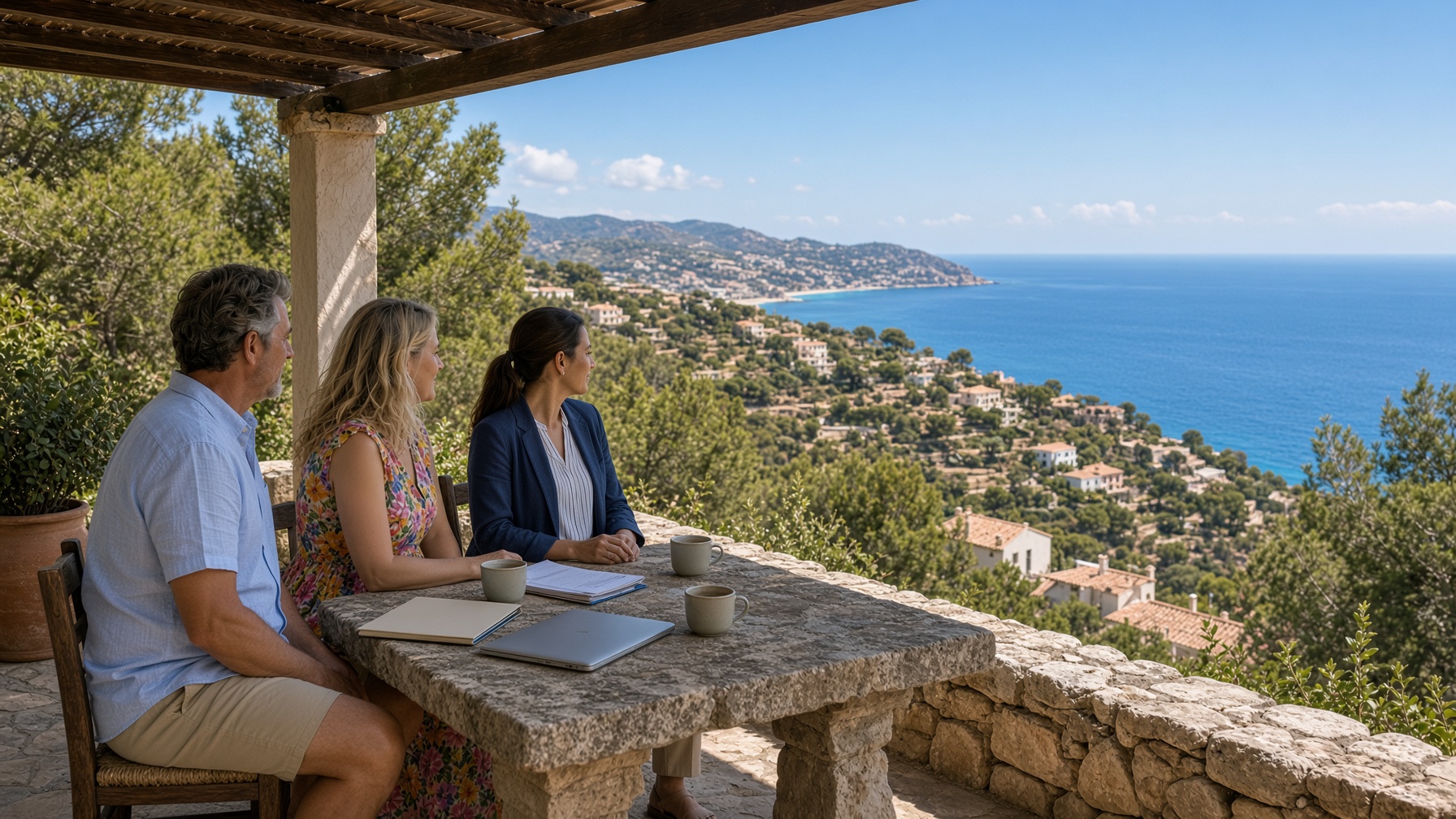
An afternoon with the numbers in front of you is the right moment to compare a resale at 9% with a new build at 10% plus 1.4%. The cheaper tax is not always the better house.
If the seller does not live in Spain
When the seller is a non-resident, the buyer withholds 3% of the price and pays it to the Spanish tax agency on account of the seller’s gain. That 3% comes out of the price paid to the seller. Done correctly, it is not a second purchase tax on you. The paperwork still has to be filed.
Municipal plusvalía, the local tax on the increase in the land value, is normally the seller’s bill. If the seller is a non-resident, the buyer can be left holding it. Your lawyer checks both points before the notary appointment.
After the keys, while you still live in the Netherlands
Owning the house does not by itself make you a Spanish tax resident. If you keep your tax residence in the Netherlands, Spain still taxes the Spanish property.
- IBI, the council tax, is yearly. The amount follows the cadastral value and the local rate, not the purchase price.
- Community fees are yearly too. In an urbanisation they can matter more than people expect. Ask for the latest minutes and the current budget before you commit.
- Modelo 210 is the non-resident return. For someone who is tax-resident in the Netherlands, the rate on that Spanish property income is 19%. A home you do not let is still declared. The taxable amount is a notional income, 1.1% or 2% of the cadastral value, depending on when that value was revised. Your gestor reads the IBI bill and applies the right percentage. Each owner files their own share.
- If you let the house, you declare the rent, and you need the right to let it: the regional tourist rules, the community statutes, and a possible VAT change on short stays that was not settled when this was written. Those are separate guides. Do not fold a week’s rent into the purchase budget until the licence is real.
Doing the purchase from the Netherlands
Two trips are a normal shape. One to choose the house. One to sign, unless the power of attorney is already in place for the notary. A third trip is common when the first shortlist was wrong.
A Spanish bank will consider a mortgage for a non-resident. How much of the price it will lend is that bank’s decision. This guide does not quote a percentage. Borrowing in the Netherlands, against a Dutch home, is a different loan. The Spanish purchase itself is paid in euros.
Bring the questions that are local: how the road works in August, what the community has voted, whether the pool is licensed, and what sold on that street in the last year.
What to look at in Jávea
Jávea is not one market.
- The old town and the streets around the church are a walkable town of stone and white houses.
- The port is a different daily life, closer to the water and busier in season.
- The Arenal is the long beach, and the flats and houses behind it.
- The hills and urbanisations trade a view and a pool for a car, and for fees.
Moraira, Dénia, Benissa and Benitachell are worth a day if the brief is this part of the coast, not this town. They are not the same search.
The house that photographs well and the house whose paperwork is clean are not always the same house. Community fees, the pool and the energy certificate decide more second visits than a national headline.
Bottom line
A Dutch citizen can buy in Jávea in 2026 in their own name. Plan the NIE and your own lawyer first. On a resale, budget ITP at 9% up to €1,000,000, and ask the lawyer to test any price near or over that line before you pay a deposit. On a new build, budget 10% VAT and 1.4% stamp duty, and do not transfer stage payments without the guarantee checks. After completion, a non-resident still files in Spain.
If you want a shortlist in Jávea, or a straight reading of one house before you fly, talk to Moments Estates. We will tell you what is actually for sale in that part of town, and which number belongs with your lawyer.
.jpeg)